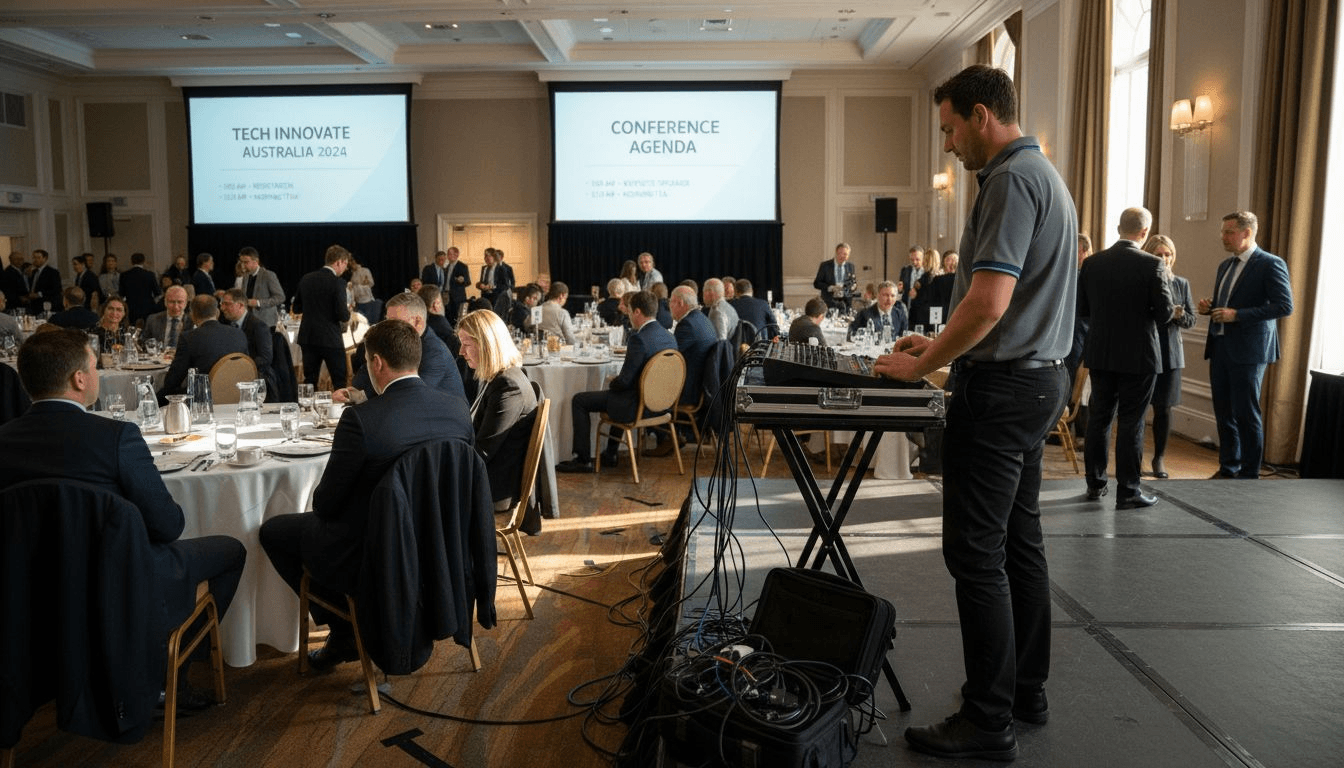
Selecting the right audio visual setup can make or break your corporate event, yet the sheer range of options often overwhelms even experienced planners. A clear evaluation framework transforms this complexity into manageable decisions. This article explores proven AV setup types with practical insights, detailed comparisons, and expert recommendations to help you deliver flawless events across Australia.
Table of Contents
- Key criteria for evaluating audio visual setups
- Basic audio visual setups for corporate events
- Hybrid and immersive audio visual setups
- AI-enhanced and wellness-focused audio visual innovations
- Comparison of audio visual setup options for corporate events
- Professional audio visual solutions for your next corporate event
- Frequently asked questions
Key takeaways
| Point | Details |
|---|---|
| Selection criteria | Evaluate audio quality, power capacity, reliability, and remote participation features before choosing an AV setup. |
| Setup variety | Options range from basic PA systems to AI-enhanced hybrid solutions with spatial audio and wellness features. |
| Power planning | Verify venue power infrastructure early to avoid costly onsite surprises and compatibility failures. |
| Professional reliability | Yamaha equipment delivers user-friendly operation and proven reliability for corporate events of all scales. |
Key criteria for evaluating audio visual setups
Before exploring specific AV configurations, you need a solid foundation for assessment. The right setup depends on five critical factors that directly impact event success and participant experience.
Power capacity and distribution determine what you can safely run, how you'll route cable, and how much headroom you have for last-minute additions. Most corporate venues provide standard 10-amp circuits, but hybrid or immersive setups often require dedicated 15-amp or three-phase connections. Sound quality and ease of operation prevent technical disasters mid-presentation. Equipment that's intuitive for your team reduces setup time and troubleshooting stress.
Well-being features like ambient lighting control and acoustic treatment create comfortable environments that keep participants focused. Remote participation capabilities have become non-negotiable for modern corporate events. Hybrid-First Architecture employs multiple camera angles, spatial audio, and life-size displays to improve remote participant engagement.
Consider these essential evaluation points:
- Audio clarity across the entire venue space without feedback or dead zones
- Visual display size and resolution appropriate for room dimensions and content type
- Compatibility with existing venue infrastructure and your presentation devices
- Scalability to accommodate last-minute attendance changes or format adjustments
- Technical support availability during setup, event runtime, and breakdown
If the venue can't speak fluently about its own power infrastructure, assume you'll be funding additional solutions or choose a different room. Verifying these details weeks before your event date prevents emergency equipment rentals and stressed technicians.
Pro Tip: Request detailed venue power specifications including circuit locations, amp ratings, and phase availability during your initial site inspection, then share them with your AV provider for compatibility verification.
Effective coordinating AV equipment for conferences requires matching these criteria against your specific event goals, audience expectations, and budget constraints.
Basic audio visual setups for corporate events
Basic configurations serve straightforward presentations, small team meetings, and budget-conscious events where sophisticated technology isn't essential. These setups typically include a PA system with one or two microphones, a projector or LED display, and simple playback capability.
Yamaha's audio products are known for intuitive operation and user-friendly design, even for those with little engineering experience. This reliability makes Yamaha equipment ideal for organisations without dedicated AV staff. Basic setups excel in venues under 100 attendees where presenter amplification and visual support are the primary needs.
Typical components include:
- Portable PA system with 300 to 500 watts output
- Wireless handheld or lapel microphone for presenter mobility
- Projector with 3000 to 4000 lumens brightness or 55 to 65 inch display
- HDMI connectivity for laptop and mobile device presentations
- Basic mixer for volume control and simple audio adjustments
Limitations become apparent with larger audiences, multiple presenters, or events requiring remote participation capabilities. Basic setups lack advanced features like camera switching, live streaming infrastructure, or sophisticated sound reinforcement. They're quick to deploy and budget-friendly, making them perfect for internal team updates, training sessions, or small client presentations.
Professional audio visual equipment hire services provide quality basic packages with technical support, ensuring reliable operation without long-term equipment investment. The simplicity of basic setups reduces setup time to under two hours for experienced technicians.
Hybrid and immersive audio visual setups
Hybrid configurations bridge physical and virtual participation, creating unified experiences for in-room and remote attendees. Immersive setups transform passive viewing into engaging, multi-sensory environments through spatial audio and interactive visual technologies.
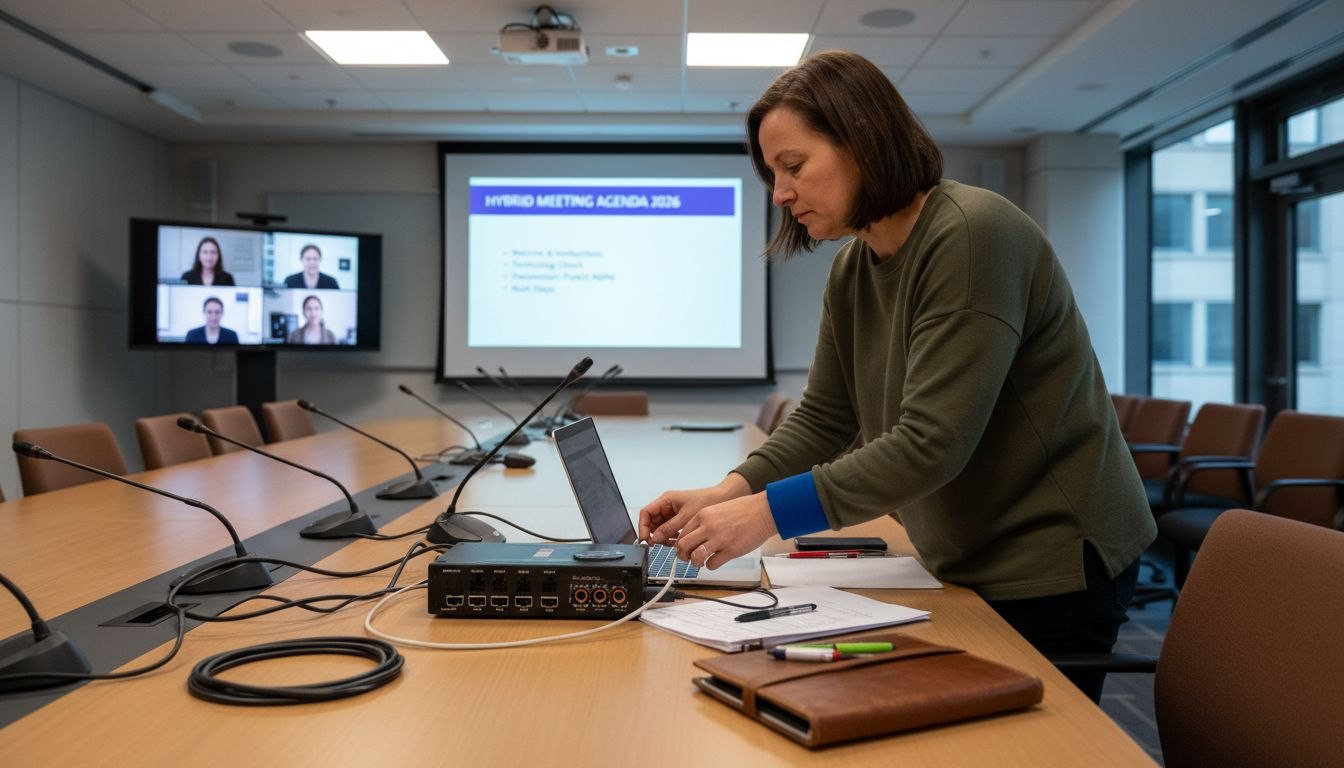
Hybrid systems integrate professional cameras, streaming encoders, confidence monitors for remote participant visibility, and bi-directional audio systems. Hybrid-First Architecture employs multiple camera angles, spatial audio, and life-size displays of virtual attendees to improve remote participant engagement dramatically. This approach treats remote participants as equals rather than afterthoughts.
Immersive setups use panoramic projection, surround sound arrays, and interactive touch displays to create memorable experiences. They excel at product launches, brand activations, and conferences where engagement directly impacts event ROI.
Key capabilities include:
- Multi-camera switching for dynamic visual storytelling and speaker tracking
- Spatial audio processing that creates natural sound positioning
- Interactive displays supporting real-time collaboration and annotation
- Professional lighting design that flatters presenters and enhances camera quality
- Dedicated streaming platforms with chat integration and audience polling
Both configurations require robust technical infrastructure and skilled operators. Professional venue audio visual management ensures seamless integration between components and troubleshoots issues before they disrupt your event.
| Feature | Hybrid Setup | Immersive Setup |
|---|---|---|
| Primary Focus | Remote participation equality | Sensory engagement |
| Camera Count | 2 to 4 professional cameras | 1 to 2 plus content feeds |
| Audio System | Bi-directional with echo cancellation | Surround sound array |
| Display Technology | Confidence monitors plus main screens | Panoramic projection or LED walls |
| Typical Event Types | Conferences, board meetings, webinars | Product launches, exhibitions, galas |
| Setup Complexity | High (3 to 5 hours) | Very High (6 to 8 hours) |
These advanced setups transform standard corporate events into engaging experiences that participants remember and discuss long after conclusion.
AI-enhanced and wellness-focused audio visual innovations
Cutting-edge AV technology now automates complex tasks and prioritises participant wellbeing, representing the future direction of corporate event production. These innovations reduce manual operator intervention while improving accessibility and comfort.
AI-Enhanced Experiences automatically optimise cameras, audio, noise reduction, and generate real-time transcriptions and summaries. Smart camera systems track active speakers and adjust framing without human intervention. AI-powered noise suppression eliminates background interference that traditional audio processing misses.
Wellness-centric features address the often-overlooked impact of environment on participant focus and retention. Wellness-Centric Features ensure ambient lighting, air quality monitoring, and acoustic treatments that support mental well-being throughout extended sessions.
Advanced capabilities include:
- Automatic speaker tracking cameras that eliminate manual operation
- Real-time language translation for multilingual audiences
- Adaptive lighting systems that adjust colour temperature throughout the day
- Acoustic treatments that reduce fatigue from prolonged audio exposure
- Intelligent volume levelling that compensates for speaker voice variations
These innovations require knowledgeable technicians who understand both the technology and optimal configuration for different event types. Experienced AV technicians leverage AI tools to enhance rather than replace human expertise, ensuring technology serves your event goals rather than dictating limitations.
Pro Tip: Combine AI automation with wellness features to create inclusive environments where both in-person and remote participants can engage comfortably for extended periods without fatigue or distraction.
The investment in these technologies pays dividends through improved participant satisfaction scores, better information retention, and reduced post-event complaints about discomfort or accessibility barriers.
Comparison of audio visual setup options for corporate events
Direct comparison helps you match event requirements with appropriate AV solutions. This table synthesises key differentiators across setup types to guide your selection process.
| Setup Type | Audio Quality | Reliability Rating | User-Friendliness | Cost Range (AUD) | Ideal Event Size | Required Expertise |
|---|---|---|---|---|---|---|
| Basic | Good for small rooms | High | Very High | $800 to $2,000 | Under 100 | Minimal |
| Hybrid | Excellent bi-directional | High | Moderate | $3,500 to $8,000 | 50 to 300 | Professional |
| Immersive | Superior spatial | Very High | Moderate | $6,000 to $15,000 | 100 to 500 | Expert |
| AI-Enhanced | Adaptive optimisation | Very High | High | $8,000 to $20,000 | 100 to 1,000 | Expert |
Yamaha prioritises reliability in its professional audio gear, understanding that system failure is not an option for live performances. This commitment to dependability makes Yamaha components popular across all setup tiers.
Scalability represents another crucial factor. Basic setups accommodate modest growth but struggle beyond their design capacity. Hybrid and immersive configurations offer flexibility through modular expansion. AI-enhanced systems adapt to varying audience sizes through intelligent optimisation.
Cost ranges reflect typical full-day hire including delivery, setup, operation, and breakdown for Melbourne metro venues. Remote locations, multi-day events, and custom requirements increase investment. Budget-conscious planners often achieve excellent results with basic or hybrid configurations rather than overextending into unnecessary complexity.
Professional coordinating AV equipment services help you right-size technology to match event goals without overspending on features you won't utilise. They provide honest assessments of what will deliver value versus what might impress but won't impact your event outcomes.
Professional audio visual solutions for your next corporate event
Transforming these AV insights into flawless event execution requires experienced partners who understand both technology and corporate event dynamics. Professional services eliminate the stress of equipment coordination, technical troubleshooting, and operator management.
Quality audio visual equipment hire provides access to current technology without capital investment or storage concerns. Expert audio visual solutions bring tailored configurations that match your specific event requirements, audience expectations, and venue constraints. Dedicated audio visual technicians manage setup, operation, and troubleshooting so you can focus on content and participant experience rather than technical details.
Early engagement with AV specialists optimises planning timelines and prevents last-minute complications that inflate costs and stress levels.
Frequently asked questions
What audio visual setup works best for corporate events under 100 attendees?
Basic PA systems with wireless microphones and a quality projector or display serve most small corporate events effectively. These configurations deliver clear audio and visual support without unnecessary complexity or cost.
How do hybrid setups accommodate remote participants effectively?
Hybrid systems use multiple cameras, bi-directional audio with echo cancellation, and confidence monitors showing remote attendees at life-size scale. This technology creates engagement parity between in-room and virtual participants.
Why do event planners consistently choose Yamaha audio equipment?
Yamaha delivers intuitive operation that non-technical staff can manage, combined with professional-grade reliability that prevents mid-event failures. This balance of user-friendliness and performance suits corporate environments perfectly.
How can I avoid power and compatibility issues at my event venue?
Request detailed power specifications including circuit locations, amp ratings, and phase availability during initial venue inspection. Share these details with your AV provider weeks before the event for compatibility verification and contingency planning.
What budget should I allocate for professional AV equipment hire?
Basic setups start around $800, hybrid configurations range from $3,500 to $8,000, and immersive or AI-enhanced systems can exceed $20,000 depending on scale and duration. Expert audio visual solutions providers offer transparent quotes based on your specific requirements and venue characteristics.