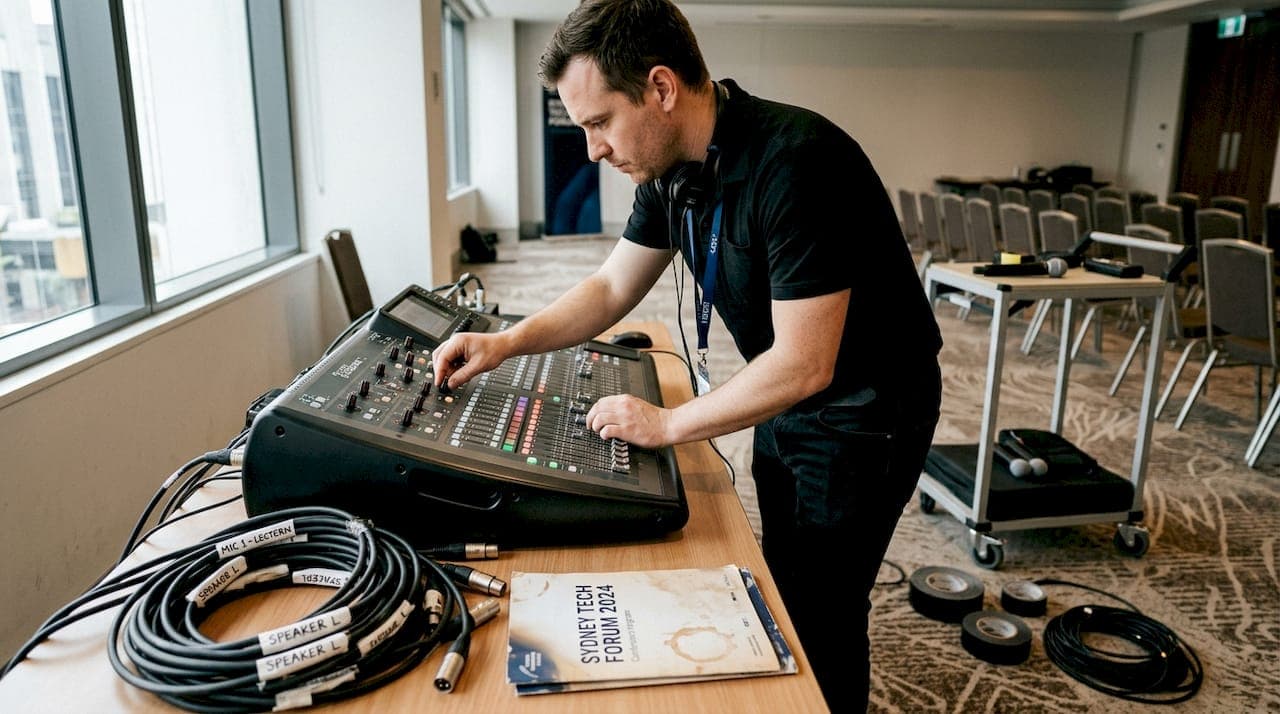
Most event planners spend months perfecting the venue, catering, and programme, yet audio remains an afterthought until something goes wrong. That assumption is costly. Professional sound design can reduce noise complaints by up to 95%, which tells you everything about the gap between basic audio setup and genuine sound design. This article walks you through what event sound design actually means, how experts approach it, how to balance immersion with clarity, and how to choose the right partners for your next corporate conference or business gathering in Australia.
Table of Contents
- What is event sound design?
- How experts approach sound design for events
- Balancing immersion with clarity: creative and technical approaches
- Practical case studies: Australian venues and benchmarks
- Common challenges and pitfalls to avoid
- How to engage the right sound partners
- Create flawless event audio with expert support
- Frequently asked questions
Key Takeaways
| Point | Details |
|---|---|
| Sound design boosts engagement | Expert-designed audio increases attendee focus and satisfaction at corporate events. |
| Professional planning prevents complaints | Pre-event modelling and tuning reduce noise problems and ensure clarity for every attendee. |
| Balance creative and technical priorities | A blend of immersive soundscapes and clear speech delivers the most effective event experience. |
| Partner with certified specialists | Engaging the right AV experts ensures success—ask for clear results and proven benchmarks. |
What is event sound design?
Event sound design is far more than pointing a speaker at an audience. As The Event Planner Expo explains, event sound design applies specialised principles to live events to create engaging audio experiences. It is a discipline that considers every sonic element in the room, from the first welcome address to the background music during networking breaks.
"Sound design is not just about volume. It is about shaping how your audience feels, focuses, and connects throughout every moment of your event."
Understanding why event audio matters is the foundation for making smarter decisions as a planner. The core goals of event sound design include:
- Speech intelligibility: Every attendee, regardless of where they sit, must hear and understand every word clearly.
- Mood and branding: Sound sets the emotional tone of your event, reinforcing your organisation's identity.
- Technical reliability: Equipment must perform consistently across the full duration of the event without dropouts or feedback.
- Audience comfort: Volume levels and frequency balance must remain comfortable, never fatiguing or distracting.
For a broader overview of what goes into a professional setup, our event AV guide covers the full picture. Sound design sits at the heart of that picture.
How experts approach sound design for events
After understanding what event sound design is, the next step is to see how experts turn theory into a flawless audio reality. Professional sound engineers follow a structured process, and skipping any step creates risk.
- Venue assessment: Engineers visit or review detailed plans of the space, noting dimensions, surface materials, ceiling height, and potential acoustic problems.
- Acoustic modelling: Using tools such as Soundvision or Bose Modeler, engineers simulate how sound will behave in the room before a single cable is run. Pre-event planning includes venue modelling, testing, DSP tuning, zoning, and advanced spatial techniques.
- Equipment selection: Speaker arrays, subwoofers, delay fills, and microphone systems are chosen based on the modelling data, not guesswork.
- Configuration and zoning: Digital signal processing (DSP) is programmed to manage different zones within the venue, ensuring consistent coverage from front to back.
- Live tuning: On the day, engineers run real-time measurements and adjust the system to account for crowd absorption and any last-minute layout changes.
Certified integrators and venue-specific modelling lead to measurable audio benchmarks that you can hold your team accountable to. Our venue-specific AV solutions are built around exactly this kind of rigorous process.
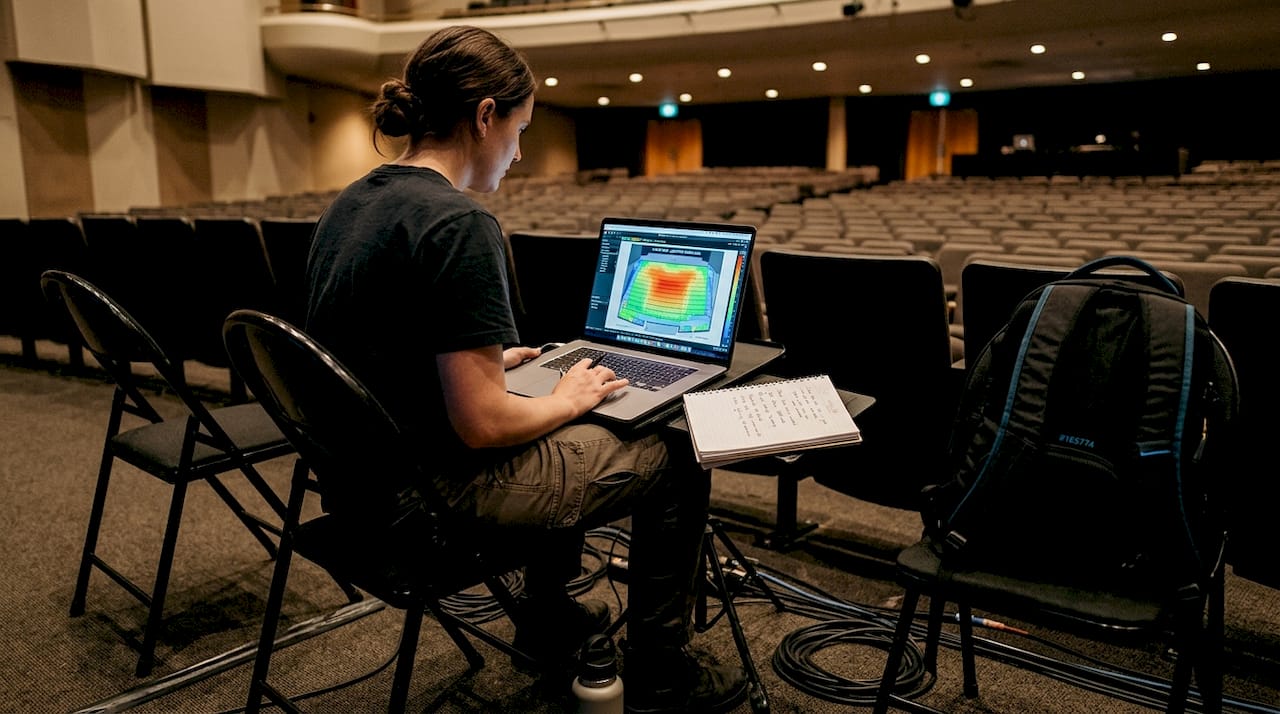
Pro Tip: Always insist on pre-event acoustic modelling for large venues or rooms with challenging layouts such as low ceilings, hard floors, or irregular shapes. A model produced before the event day saves hours of troubleshooting on the day itself.
Here is a quick comparison of the two approaches:
| Approach | Planning depth | Tools used | Outcome reliability |
|---|---|---|---|
| Basic audio setup | Minimal | Standard PA, no modelling | Variable, risk of issues |
| Professional sound design | Thorough | DSP, modelling software, zoning | Consistent, measurable |
For a full breakdown of AV equipment for events, including what to expect from a professional rig, our solutions page is a useful reference. You can also review our conference AV guide for a complete overview of what a well-designed system looks like.
Balancing immersion with clarity: creative and technical approaches
With the process overviewed, let us examine the art and science of curating both immersive and intelligible event soundscapes. This is where many events fall short, because planners tend to prioritise one at the expense of the other.
Technical clarity ensures every attendee hears well. This is non-negotiable for speeches, panel discussions, and presentations. Experts note that both immersion and clarity are required for optimal effect, and neither should be sacrificed.
"The most memorable corporate events are those where attendees never once thought about the audio, because it simply worked perfectly from start to finish."
Creative soundscaping, on the other hand, sets the mood, supports your brand, and heightens the emotional response of your audience. Think of the difference between walking into a silent room versus one with carefully chosen ambient music at the right tempo and volume. The second experience signals professionalism and intention.
Here are practical ways to achieve both:
- Layer ambient sound thoughtfully: Use background music during arrivals and breaks, but reduce it to near silence during keynote sessions.
- Match tempo to session type: Upbeat tracks work for networking; slower, neutral tones suit workshops and breakout sessions.
- Prioritise speech intelligibility for keynotes: Vocal-focused voicing, AI-assisted mixing, and integration with other show elements keep the speaker front and centre.
- Use zoning to separate experiences: A gala dinner in one section and a breakout session in another can coexist without bleed-over when zones are properly configured.
Pro Tip: Brief your AV team on the emotional arc of your event, not just the technical schedule. Knowing that a keynote is followed by an awards segment helps engineers prepare smooth transitions that feel intentional rather than abrupt.
For inspiration on how AV setups for events can be tailored to different session types, and how event theming solutions integrate with audio, explore our resources. Engaging event audio is always the result of deliberate planning, not chance.
Practical case studies: Australian venues and benchmarks
Theory is essential, but seeing these principles in practice helps bridge the gap. Here is how leading Australian venues get it right.
Australian venues such as the Geelong Arts Centre, major convention centres in Brisbane, and large-scale raceways have invested heavily in professional sound design. Advanced line arrays deliver even coverage across 10,000-plus capacity spaces, with professional design reducing complaints by 95% and achieving front-to-back level drop-off under 10dB. Systems from manufacturers such as L-Acoustics, Martin Audio, and Bose are commonly specified for these environments.
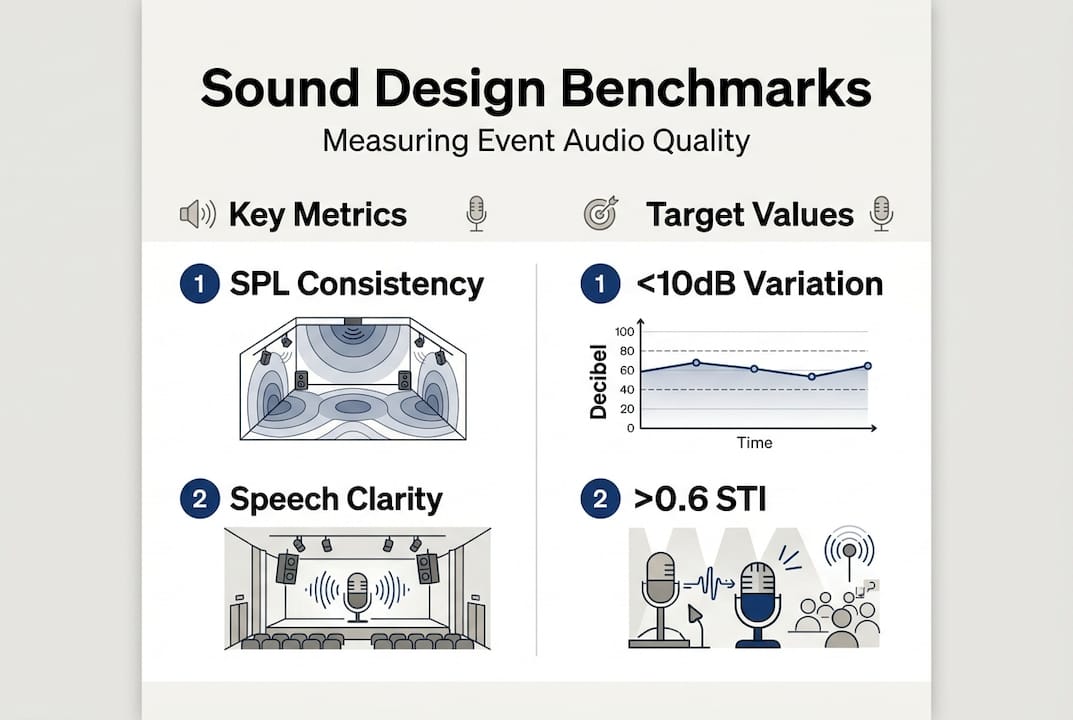
Key performance benchmarks to request from your AV team:
| Benchmark | What it measures | Target value |
|---|---|---|
| SPL consistency | Volume evenness across the room | Less than 10dB front-to-back variance |
| STI (Speech Transmission Index) | Speech clarity and intelligibility | 0.6 or above |
| Noise complaint reduction | Outcome of professional design | Up to 95% reduction |
| Frequency response | Tonal balance across the space | Flat within ±3dB |
The One Raceway case study and the Geelong Arts Centre upgrade are excellent references for understanding what best-practice sound design delivers in real Australian venues. Our event AV solutions are designed to meet these same benchmarks, and our AV management for events process ensures nothing is left to chance.
Common challenges and pitfalls to avoid
Of course, no project is without hurdles. Here is what to watch for so you stay ahead of common sound design issues.
Even experienced planners encounter problems when sound design is not given the attention it deserves. Edge cases include complex room layouts, outdoor sound propagation, hybrid and virtual event needs, and the unpredictable acoustic effect of a full crowd absorbing high frequencies. Each of these requires a specific response.
Common pitfalls include:
- Skipping acoustic modelling: Assuming a system that worked in one venue will work in another is a frequent and expensive mistake.
- Ignoring acoustic flexibility: Dividable ballrooms and multi-use spaces need matrixed, zoned solutions, not a single fixed system.
- Underestimating crowd absorption: A room that sounds perfect during a sound check can become muddy and unclear once filled with people.
- Outdoor unpredictability: Wind, temperature changes, and reflective surfaces all affect how sound travels outdoors.
- Hybrid event neglect: Remote attendees need their own audio mix, separate from the in-room experience, to hear clearly.
Pro Tip: For venues near residential areas or other event spaces, always ask your engineer to notch out problem frequencies in the low-mid range. This targeted approach reduces neighbour noise issues without compromising the in-room experience.
Our AV solutions for tricky venues address all of these scenarios, and our team understands the specific acoustic challenges of Australian event spaces. Exploring your venue AV potential early in the planning process is always the right move.
How to engage the right sound partners
To ensure all your sound investments pay off, here is how to select and work with expert AV partners for corporate events.
Choosing the right partner is as important as the technology itself. Follow these steps to vet and engage a qualified team:
- Check certifications and track record: Look for engineers with recognised industry certifications and a portfolio of events similar in scale and type to yours.
- Ask for acoustic modelling examples: Any credible partner should be able to show you simulation outputs from previous projects.
- Request event references: Speak to other event planners who have worked with the team, and ask specifically about on-the-day performance.
- Demand clear metrics: Ask for SPL targets, STI ratings, and a written plan for how they will achieve them in your specific venue.
- Confirm post-event review: A good partner will debrief after the event, sharing measurement data and lessons for future improvements.
Certified integrators and venue-specific modelling are central to professional results in Australian events. When you work with trusted AV partners, you gain access to both the technical expertise and the project management discipline that complex events demand.
Create flawless event audio with expert support
If you are ready to elevate your corporate event audio and apply these insights, working with a specialist AV partner makes every step more manageable and more effective.
At Conference Audio Visual, we bring together skilled engineers, state-of-the-art equipment, and a structured process that covers everything from initial venue assessment through to live tuning and post-event review. Our audio visual solutions are tailored to the specific demands of your event, whether you are running a 50-person boardroom session or a 5,000-seat national conference. We handle the complexity so you can focus on delivering a great experience for your attendees. Explore our event AV guide or get in touch with our team to arrange a venue walkthrough and custom acoustic modelling consultation.
Frequently asked questions
What's the difference between sound design and basic event audio setup?
Sound design is a strategic process using acoustic modelling, zoning, and creative techniques tailored to the room and event goals, while a basic setup simply amplifies sound without any of that customisation. The difference in attendee experience is significant and measurable.
How does poor sound design impact event outcomes?
Poor sound design leads to disengaged attendees, lost messaging, and avoidable technical complaints. Professional sound design can reduce noise complaints by up to 95%, which reflects the real-world gap between a reactive and a planned approach.
What are the key benchmarks I should ask my AV team for?
Insist on even SPL coverage with less than 10dB front-to-back variance, and STI ratings of 0.6 or above for speech clarity. Ask for documented case studies showing complaint reduction as well.
How can sound design handle unusual venue layouts?
By using advanced acoustic modelling, flexible zoning, and real-time DSP tuning, engineers can adapt for dividable ballrooms, outdoor spaces, or complex room layouts that would otherwise cause uneven coverage or feedback issues.
Is sound design worth it for smaller corporate events?
Absolutely. Tailored sound improves focus, comfort, and message retention even in smaller spaces, and professional tuning prevents the feedback and clarity issues that distract attendees and undermine your event's credibility.