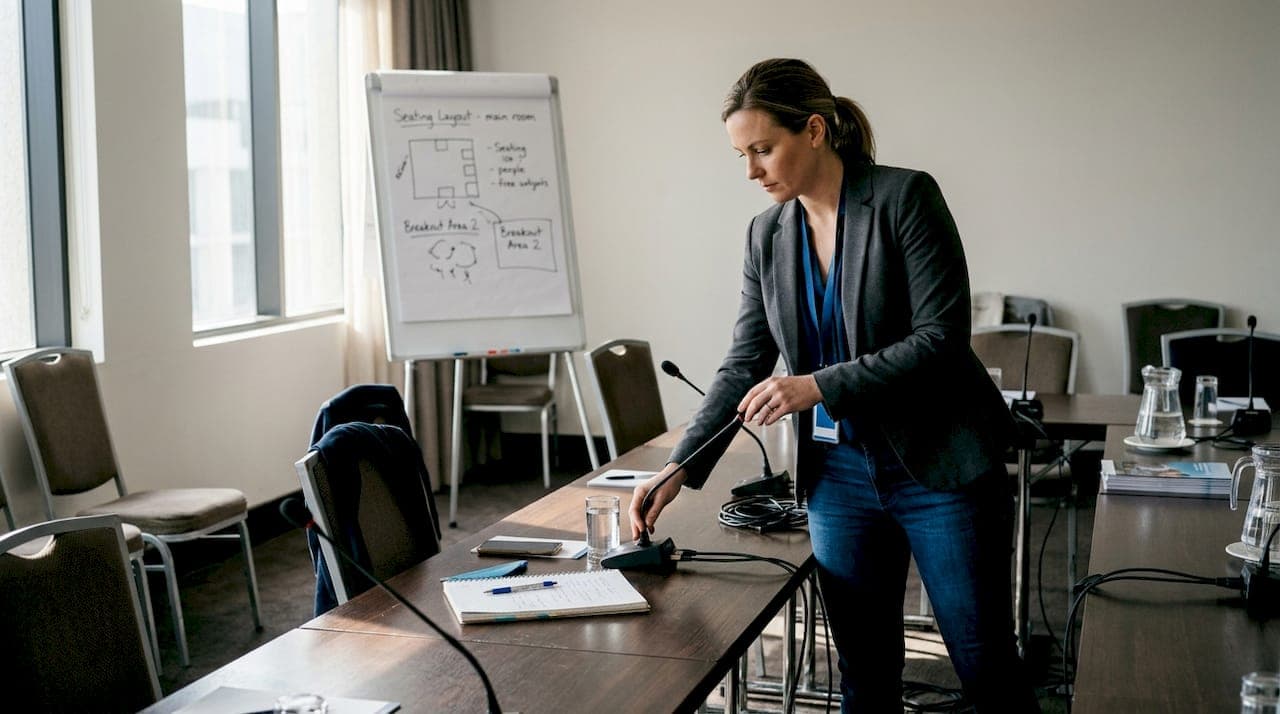
Many planners assume any microphone will suffice for corporate events, yet specialised conference microphone systems deliver speech clarity and seamless AV integration that generic equipment cannot match. Choosing the right system involves understanding microphone types, wireless versus wired trade-offs, and setup strategies that eliminate dropouts and ensure professional audio. This guide explains the technology, practical considerations, and performance benchmarks that help you enhance event communication and attendee experience.
Table of Contents
- Key Takeaways
- Understanding what a conference microphone system is
- Types of conference microphones and their uses
- Wired vs wireless conference microphone systems: pros and cons
- Benchmark performance and practical setup considerations
- Explore professional audio visual solutions for corporate events
- Frequently asked questions
Key Takeaways
| Point | Details |
|---|---|
| Specialised systems for clarity | Conference microphone systems prioritise intelligibility and seamless AV integration over generic mics. |
| Microphone types overview | Key types include podium gooseneck, lavalier headset, boundary table, and ceiling array microphones, each suited to different room sizes and speaker mobility. |
| Wireless versus wired | Wireless options offer mobility but require frequency management, while wired options deliver reliability. |
| Redundancy and coordination | Redundancy and proper frequency coordination are crucial to avoid dropouts and ensure seamless communication. |
Understanding what a conference microphone system is
A conference microphone system is a specialised audio setup designed for clear speech capture and event AV integration. Unlike generic microphones that serve broad purposes, conference systems focus on intelligibility, participation management, and hybrid or multilingual support. These systems connect to mixers, amplifiers, and recording devices to create a cohesive conference AV guide that supports professional events.
Conference microphone systems excel in scenarios where multiple speakers present, panels discuss topics, or hybrid audiences join remotely. They manage turn-taking, reduce feedback, and maintain consistent audio levels across diverse speaking styles. This capability is crucial for boardroom meetings, shareholder briefings, and large-scale conferences where communication clarity directly impacts event success.
Core functions include:
- Capturing speech with minimal background noise
- Integrating with DSP units for echo cancellation and automatic gain control
- Supporting simultaneous interpretation and recording
- Providing flexible speaker management through push-to-talk or voice-activated modes
Seamless AV integration ensures microphones work with existing sound systems, video conferencing platforms, and recording equipment. Planners must consider compatibility with mixers, wireless frequency bands, and power distribution to avoid technical issues. Professional conference systems deliver reliability that generic consumer microphones cannot match, making them essential for high-stakes corporate events.
Types of conference microphones and their uses
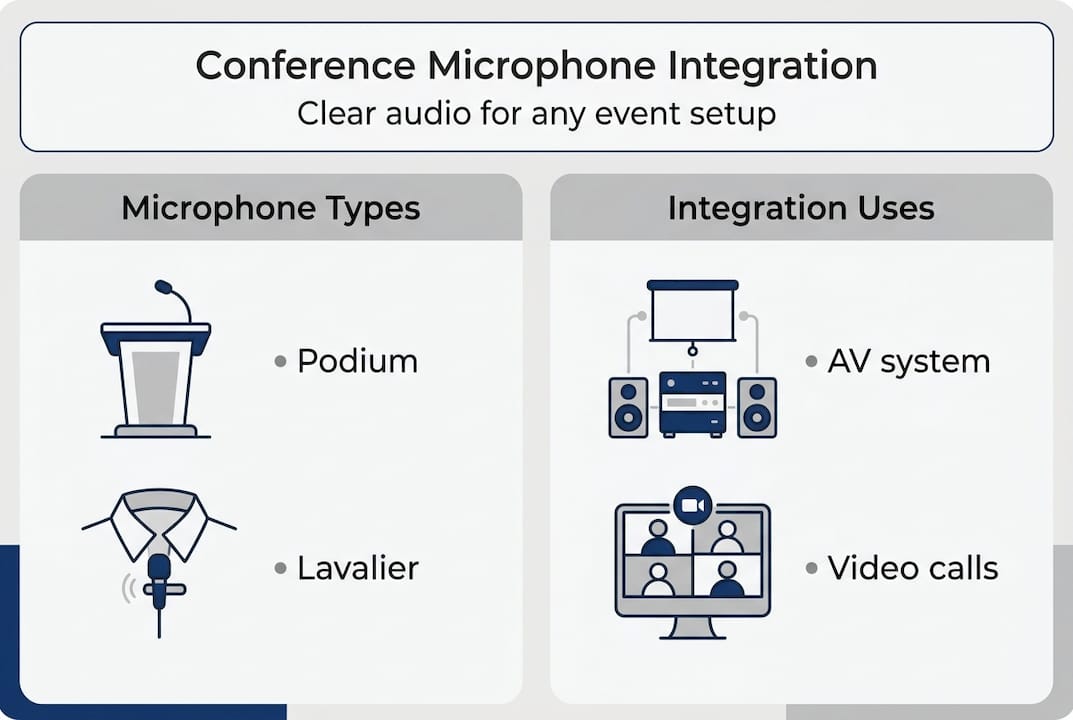
Understanding microphone types helps planners match equipment to event formats and speaker needs. Key types include podium/gooseneck, lavalier/headset, boundary/table, and ceiling arrays for various roles and room sizes. Each type offers distinct advantages based on speaker mobility, room acoustics, and event structure.
Podium or gooseneck microphones attach to lecterns and provide fixed capture for keynote speakers. Their directional pickup pattern isolates the speaker's voice while rejecting ambient noise, making them ideal for formal presentations. Gooseneck designs allow height and angle adjustments to suit different speaker heights without compromising audio quality.
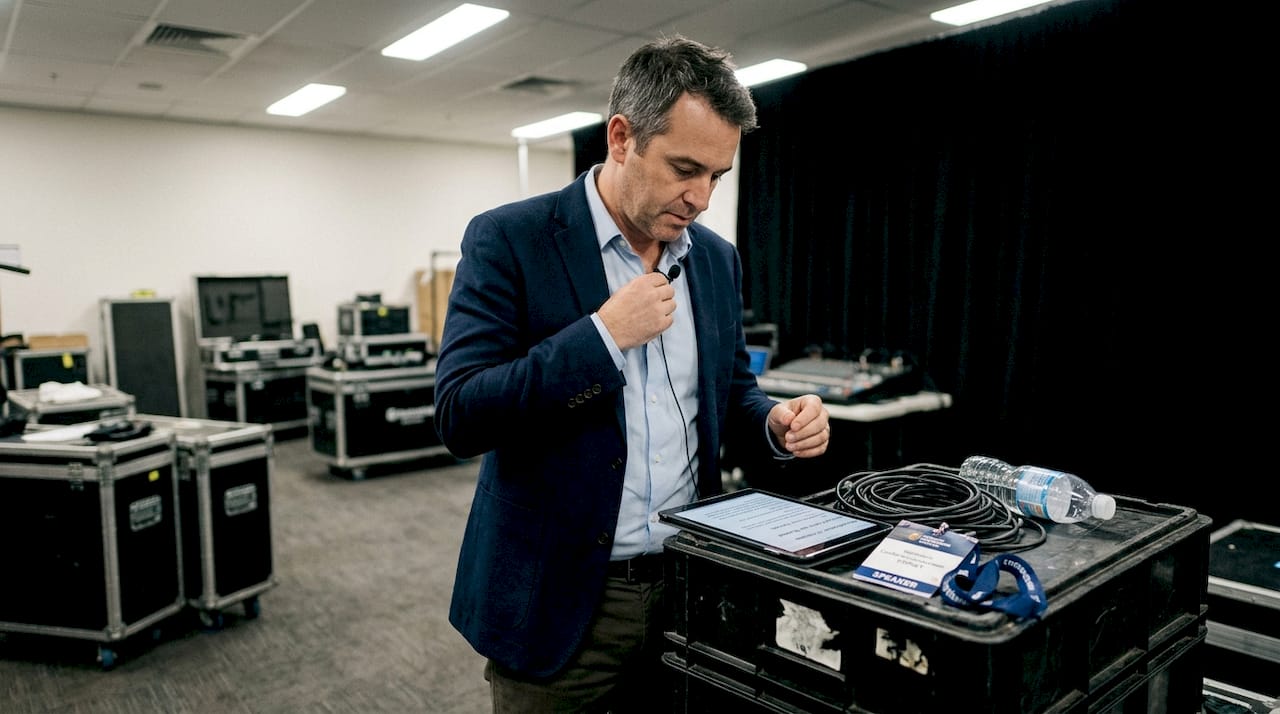
Lavalier and headset microphones clip to clothing or wrap around the head, offering hands-free operation and mobility. Presenters can move freely across stages while maintaining consistent audio levels. These microphones suit interactive sessions, demonstrations, and panel moderators who need to engage audiences without being tethered to a podium.
Boundary microphones sit flat on tables and capture voices from multiple speakers in panel discussions or roundtable meetings. Their low-profile design reduces visual clutter while providing omnidirectional or hemispherical pickup patterns. This type excels in collaborative settings where several participants contribute equally.
Ceiling array microphones use beamforming technology to focus on active speakers while rejecting background noise. They cover large areas, up to 10 by 5.5 metres, without visible equipment cluttering tables or stages. This hands-free solution suits boardrooms and hybrid meetings where remote participants need clear audio from in-room speakers.
| Microphone type | Best use case | Coverage range | Mobility |
|---|---|---|---|
| Podium/gooseneck | Keynote speeches, formal presentations | 30-60 cm | Fixed |
| Lavalier/headset | Mobile presenters, demonstrations | Body-worn | High |
| Boundary/table | Panel discussions, roundtables | 1-2 metres | Fixed |
| Ceiling array | Large rooms, hybrid meetings | Up to 10x5.5 metres | Hands-free |
Pro Tip: Consider event format and speaker mobility when selecting microphones. Fixed podiums suit formal keynotes, while lavaliers support interactive sessions. Combining types within a single event ensures coordinating AV equipment meets diverse presentation styles.
Wired vs wireless conference microphone systems: pros and cons
Wired systems offer zero interference and latency ideal for fixed installs; wireless provide mobility but require frequency coordination and battery management. Choosing between these options depends on event format, venue constraints, and technical support availability. Both systems deliver professional audio when configured correctly, but each presents unique trade-offs.
Wired microphones connect directly to mixers via XLR or TRS cables, eliminating RF interference and battery concerns. They provide consistent audio quality without dropouts, making them reliable for mission-critical presentations. Installation involves cable routing and permanent or semi-permanent setups, which suit venues hosting frequent events. However, cables restrict speaker movement and create trip hazards if not properly managed.
Wireless microphones transmit audio via radio frequencies, offering presenters freedom to move across stages and interact with audiences. They eliminate visible cables and support dynamic event formats where speakers change frequently. Yet wireless systems require careful frequency planning to avoid interference from other devices, Wi-Fi networks, and nearby wireless microphone systems. Battery life typically ranges from six to ten hours, necessitating spare batteries or charging protocols for full-day events.
Australian wireless range and use are limited by ACMA frequency regulations (520 to 694 MHz). Planners must ensure systems operate within legal bands and coordinate frequencies when multiple wireless microphones run simultaneously. Venues in urban areas face greater RF congestion, increasing the risk of interference and requiring professional frequency scanning before events.
| Aspect | Wired systems | Wireless systems |
|---|---|---|
| Reliability | Zero interference, no dropouts | Subject to RF interference |
| Mobility | Restricted by cable length | Full stage mobility |
| Setup complexity | Cable routing required | Frequency coordination essential |
| Power source | Phantom power via cable | Battery dependent |
| Legal compliance | No frequency restrictions | Must comply with ACMA regulations |
Pro Tip: Always plan for redundancy to avoid dropouts in mission-critical corporate events. Use wired backups for keynote speakers and maintain spare batteries for wireless systems. Testing wireless microphones and PA system selection tips before events identifies potential interference and ensures seamless audio delivery.
Benchmark performance and practical setup considerations
Real-world beamforming microphones clear speech at 2 to 3 metres; ceiling arrays like the Shure MXA902 cover up to 10 by 5.5 metre rooms; portable PA systems serve 100 to 500+ attendees. Understanding these benchmarks helps planners select equipment that matches room size, audience count, and event format. Proper setup optimises microphone placement, reduces latency, and ensures consistent audio quality throughout presentations.
Typical coverage distances vary by microphone type. Podium microphones capture clear speech within 30 to 60 centimetres, while boundary microphones extend coverage to one to two metres for panel discussions. Ceiling arrays leverage beamforming to focus on active speakers up to three metres away, maintaining intelligibility even in acoustically challenging rooms. Latency for digital wireless systems typically remains below five milliseconds, imperceptible to audiences.
Power requirements scale with event size. Small boardroom systems may need 50 to 100 watts, while large conference halls require 500 to 1,000 watts or more to reach audiences of several hundred attendees. Matching amplifier power to room acoustics and audience size prevents distortion and ensures even coverage. Planners should also account for power distribution, ensuring sufficient outlets and backup power for critical events.
| Equipment type | Coverage range | Latency | Power requirement |
|---|---|---|---|
| Podium microphone | 30-60 cm | <1 ms (analogue) | Phantom power (48V) |
| Lavalier wireless | Body-worn | <5 ms (digital) | Battery (6-10 hours) |
| Boundary microphone | 1-2 metres | <1 ms (wired) | Phantom power (48V) |
| Ceiling array | Up to 10x5.5 metres | <5 ms (digital) | PoE or mains power |
| Portable PA system | 100-500+ attendees | N/A | 200-1,000 watts |
"Ceiling array microphones with beamforming technology deliver exceptional speech clarity in hybrid meetings, covering large rooms while reducing visual clutter and simplifying setup for event planners."
Optimising microphone placement and system configuration involves these steps:
- Survey the venue to identify acoustic challenges such as reflective surfaces, HVAC noise, and room dimensions.
- Position microphones to maximise direct sound capture while minimising feedback and ambient noise.
- Test frequency response and adjust EQ settings to compensate for room acoustics and speaker voice characteristics.
- Coordinate wireless frequencies using spectrum analysers to avoid interference from other devices and systems.
- Establish redundancy by preparing backup microphones, batteries, and cables to address unexpected failures.
- Conduct soundchecks with actual speakers to verify audio levels, intelligibility, and system integration.
Professional setup ensures audio mixing consoles and microphones work together seamlessly, delivering the AV solutions benefits that enhance attendee experience and event success.
Explore professional audio visual solutions for corporate events
Selecting the right microphone system is just the beginning. Successful events require comprehensive AV support that integrates microphones, mixers, amplifiers, and recording equipment into a cohesive setup. Conference Audio Visual offers audio visual equipment hire tailored to corporate event needs, ensuring reliable performance and professional audio quality.
Our expert AV solutions include on-site technicians who manage setup, frequency coordination, and real-time troubleshooting. This support reduces stress for event planners and guarantees seamless communication throughout conferences, boardroom meetings, and hybrid gatherings. From podium microphones to ceiling arrays, we provide equipment that matches your event format and venue acoustics.
Pro Tip: Consult AV professionals early in event planning to ensure seamless audio experience. Early engagement allows time for venue surveys, equipment selection, and frequency coordination, preventing last-minute issues. Explore our AV equipment guide to learn more about integrating microphone systems with other AV technology for successful corporate events.
Frequently asked questions
What is the difference between boundary microphones and lapel microphones?
Boundary microphones sit on tables capturing group voices, making them ideal for panel discussions and roundtable meetings. Lapel (lavalier) microphones clip to speaker's clothing for mobile individual use, supporting hands-free presentations and dynamic stage movement. Choose boundary microphones for collaborative settings and lavaliers for solo presenters who need mobility.
How do frequency regulations in Australia affect wireless microphone use?
Australian Communications and Media Authority sets frequency bands for wireless systems, limiting operation to 520 to 694 MHz. Planning must consider frequency availability to avoid interference and legal issues, especially in urban venues with high RF congestion. Professional frequency coordination ensures compliance and prevents dropouts during events. Wireless range and use are limited by ACMA regulations, requiring careful planning for reliable performance.
What are the advantages of ceiling array microphones in large conference rooms?
Coverage of up to 10 by 5.5 metres with beamforming technology enables hands-free speaker participation and less visual clutter. Ceiling arrays automatically focus on active speakers while rejecting background noise, making them ideal for hybrid meetings and large boardrooms. They eliminate the need for table-mounted microphones, simplifying setup and reducing trip hazards.
How long do wireless conference microphone batteries typically last during events?
Wireless microphones commonly have battery life between 6 to 10 hours depending on model, supporting full-day events without replacement. Planners should prepare spare batteries to ensure uninterrupted use, especially for multi-session conferences. Testing battery levels before events and scheduling battery changes during breaks prevents unexpected failures and maintains professional audio quality throughout presentations.